
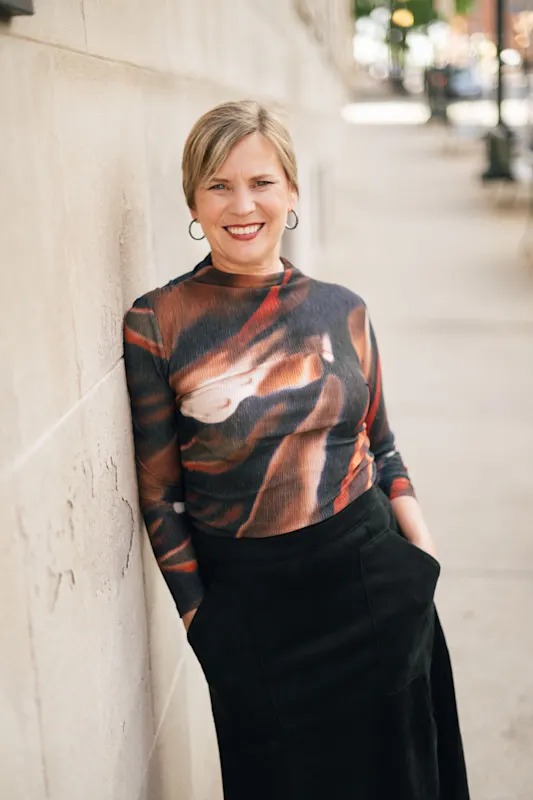
Keri Mangis on what a crisis can teach us about letting go
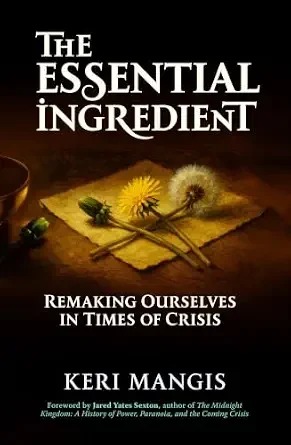
When life falls apart, how do we know what’s worth putting back together? Author and speaker Keri Mangis explores that question in her latest book, The Essential Ingredient, drawing on alchemy, fairy tales and her own experience. In this feature, she takes a closer look at the advice we hear in a crisis, from pushing through to holding out hope, and considers how we can decide for ourselves what to carry forward and what to let go.
1. You’ve said the quiet of the COVID era gave you room to research how other societies lived through crisis. What did you find that changed the way you understood our own moment?
I absorbed a wide variety of genres during this time: history, philosophy, psychology, spirituality, politics, and even fairy tales and myths. Combined, they helped me see that we humans live in cycles and spirals, not on timelines. Our modern, Western approach to life has mostly lost this broader outlook, leaving us bereft of a sense of meaning and uprooted from our rightful place in the larger cycle. My new awareness that every decline leads to renewal has brought peace and shifted my mindset to a healthier place.
As an example for how it changed my view of the current moment, allow me to share what I learned from the fairy tale, “The Girl Without Hands.” Fairy tales might seem the odd genre out at first glance, until you remember that these stories, passed down generation after generation, carry the seeds of human consciousness. They allow us to explore archetypes (common human characteristics that arise over and over in different times and people), and reveal truths that history sometimes brushes over.
In this story, a girl whose hands are cut off by her father (after he loses a bargain with the devil) seeks sanctuary with a kindly king. He marries her and makes her hands of silver. However, her life never feels quite her own. She sets off into the forest where, through time and turbulence, she grows back her own hands.
This story taught me that the safety and sanctuary we expect others to provide for us will never make us whole. At some point, we must set off on our own, awaken our power, grow back our own hands. This girl is all of us, of course, still looking for a king to save us—maybe in this politician or that messenger. Her story formed the basis of my thesis that we must stop hunting for heroes to save and restore us and instead, set out to reclaim our own power.
2. You began writing The Essential Ingredient partly to make sense of cultural breakdown for yourself. Was there a belief you had to let go of before you could write it for other people?
In my book, I advocate for shadow work, which is a process of claiming parts of ourselves we believe we have done away with, suppressed, or never had in the first place. This work can be done individually, but it can also be done by groups, families, institutions, and even countries. For me, studying and writing this book became an opportunity to do shadow work about the United States of America.
Growing up, I was taught that America was special, even “chosen”, and that in any conflict, we are the “good guys.” Through this work, I questioned that narrative, and began to see the other side of the whole truth fill in. Once I released the narrative of American exceptionalism, I could no longer believe that what’s happening here is unprecedented. As they say, history may not repeat, but it does rhyme, and America is not immune to that truth. Knowing we aren’t special helps me better see where we actually sit in the cycles and spirals of history. This work never did break me, as one might fear upon beginning. It only made me stronger. Today, my perspective is more nuanced. Broader. Less reactive. And readied me to invite others into the work.
3. The title comes from alchemy’s idea of reducing a material to its essence. What might that look like in an ordinary person’s life, without the promise that every hardship will turn into something good?
The work in my book isn’t about finding silver linings, or turning a crisis into something that we would label “good.” It’s simply about recognizing that hardships and challenges in life are often the first chance we have to release much of what we have accumulated in our lifetime.
Accumulating is what we are taught to do from childhood. Build ourselves up. Protect what we’ve built, without questioning the cost of doing so. Over the years, we pile on roles, expectations, titles, personality traits, and beliefs without ever stopping, taking inventory, and investigating. By adulthood, the persona we call “us” is stuffed with ideas, fears, inherited narratives, and expectations that keep us from remembering who we really are. It’s a heavy load.
Consider a midlife crisis, a time of life often reduced to a punchline. Now, we don’t need to turn this challenging time of life into something good, but what if we saw it truly as the first time someone has had a real opportunity to ask themselves, “What is it that I want?” Outside of the roles and expectations of society and others, this crisis asks us to lighten the load. Break free from our habits and unconscious conditioning. Surrender much of what we have accumulated out of fear, desire, or competition. And finally, choose for ourselves who we are and what we find meaningful and joyful.
This might look like remembering that we loved to sing, even if it’s a sad or angry song we choose to sing. It might look like finding our sense of humor once again, even if it’s sardonic. All the while, we begin reclaiming pieces of ourselves that we had traded away for temporary security or identity. That is work worth doing.
4. You’ve pushed back on advice to “overcome” a crisis or pull yourself up by your bootstraps. What does that advice miss about the period when someone’s life has fallen apart?
Yes, and here’s another one: “Fall down seven times, get up eight.” I hear this and think: “Maybe after falling down seven times, I need a break!” Maybe, after loss, disillusionment, or full-on devastation, we need time to reflect, reassess, and perhaps revisit our path rather than to continue relentlessly pushing.
We learn resilience, patience, and determination by never giving up. That’s the Western way. But we learn compassion, self-care, and acceptance through letting go. That’s the alchemist’s way.
So, my critique is not of the advice categorically, it’s that this is the stock advice we get and give all the time every time, giving no credence to the kind of strength and trust it takes to give up, let go, or walk away.
Ultimately, my work is about bringing balance to these approaches: the endurance it takes to try, try again, as well as the wisdom to know when enough is enough.
5. Your book takes ideas Jung applied to individual change and asks what they could mean for a whole society. Where does that analogy help us, and where might it break down?
Jung took the three stages of the alchemical experiment and used them in his psychoanalysis. So, his work was not about improving people, like a shiny coat of paint. It was about remaking them, like turning lead to gold.
My book takes this concept to the wider world and asks: What if the breakdowns and collapses we see in our institutions, collective beliefs, and trust in authority are not the end of something, but the very process necessary to make something better? Rather than an apocalyptic view of world events, or wondering if we’re living at the end of all time, this mindset suggests that perhaps we are living at the end of a time, which ignites our collective imagination about what could be next.
This can be a harder viewpoint to embrace for the collective than for an individual, because we may not be around to witness the renewal. This is where the world’s greatest spiritual traditions remind us: we are all one. As we investigate, reflect, and reassess our own lives, the culture will shift. And as we individuals, en masse, find the courage to imagine something better, the culture will soon have no choice but to follow.
6. You’ve written that you once hoped spiritual practice would bring you bliss, but it brought suppressed feelings to the surface. How did that experience change the kind of help you wanted this book to offer?
Much of the early spiritual advice I received suggested I “fake it ‘til I make it.” So I pretended. I put on a face. I acted “as if.” All this did was teach me to deny my true feelings and deeper truths, what we now recognize as “spiritual bypassing.” This went on until I hit a point where my body and my emotions would no longer cooperate in this game of pretend. I told this story in my first book, Embodying Soul: A Return to Wholeness. I think the advice I’d received was often well-meaning. Yet, isn’t there something about it that denies the power of truth? The power of expressing our lived experiences?
For The Essential Ingredient, I wanted to share the next stage in my story, in which I choose my authenticity. More than choose, I trust it. I share a story in the book in which I walk away from an entire community that had nurtured and cared for me, not because they failed in any way but because I didn’t need to borrow their truth anymore for I had found my own.
When we stop seeking ways to fake our lives, we drop into our authenticity. It was always there, waiting for us to live it. The work in my book, including the excavation of our minds, is how we tell truth from falsehood, roles and characteristics we take on because we think we have to versus those that bring us joy and purpose. There’s nothing more sacred for me than time with a friend or loved one where we meet as two authentic individuals. No pretense. Only truth. In times of crisis like we are living in now, truth and authenticity are the map.
7. You argue that hope alone cannot answer a systemic crisis. What separates hope that keeps someone engaged from hope that lets them wait for someone else to act?
We could talk about how to upgrade passive hope to active hope. Or, we could recognize that hope itself is not enough. We cannot build a new world on hope, active or otherwise. We cannot dismantle the status quo on hope, engaged or otherwise.
To get to a world that is equitable, safe, and fair for all of us, each of us needs to undergo the work of transforming our consciousness: from one that participated in the creation and upholding of this status quo to one that is capable of imagining and building something better. We are all complicit to some degree in lowering the bar for what we’re willing to accept. That is why my book doesn’t rely on hope. It calls instead for presence. Compassion. Community. Steadfastness. Love. And if you want to sprinkle that all with a bit of hope, that is where it belongs.
8. You’ve described losing faith in political heroes and spiritual gurus. Is there a person or idea you found especially hard to take off a pedestal?
As a young person, you carry this belief that the adults are in charge. You believe that they have it figured out, and they know what they’re doing. And then, somewhere in your mid-twenties, you realize they are all just trying to do the best they can. That’s how it happened for me with political heroes and spiritual gurus. Gradually, it dawned on me that they didn’t have all the answers any more than I did. This shift wasn’t an on/off switch. There was a slow period of disillusionment and a sense of being unmoored, out at sea all by myself. But eventually, I found within me the power, wisdom, and knowledge to navigate my life that I had once outsourced to them. Now, I find that I can admire others, without having to place them on a pedestal. And I can learn from others, without sitting at their feet.
