The Mexican Valley That Changed How the World Grows Wheat
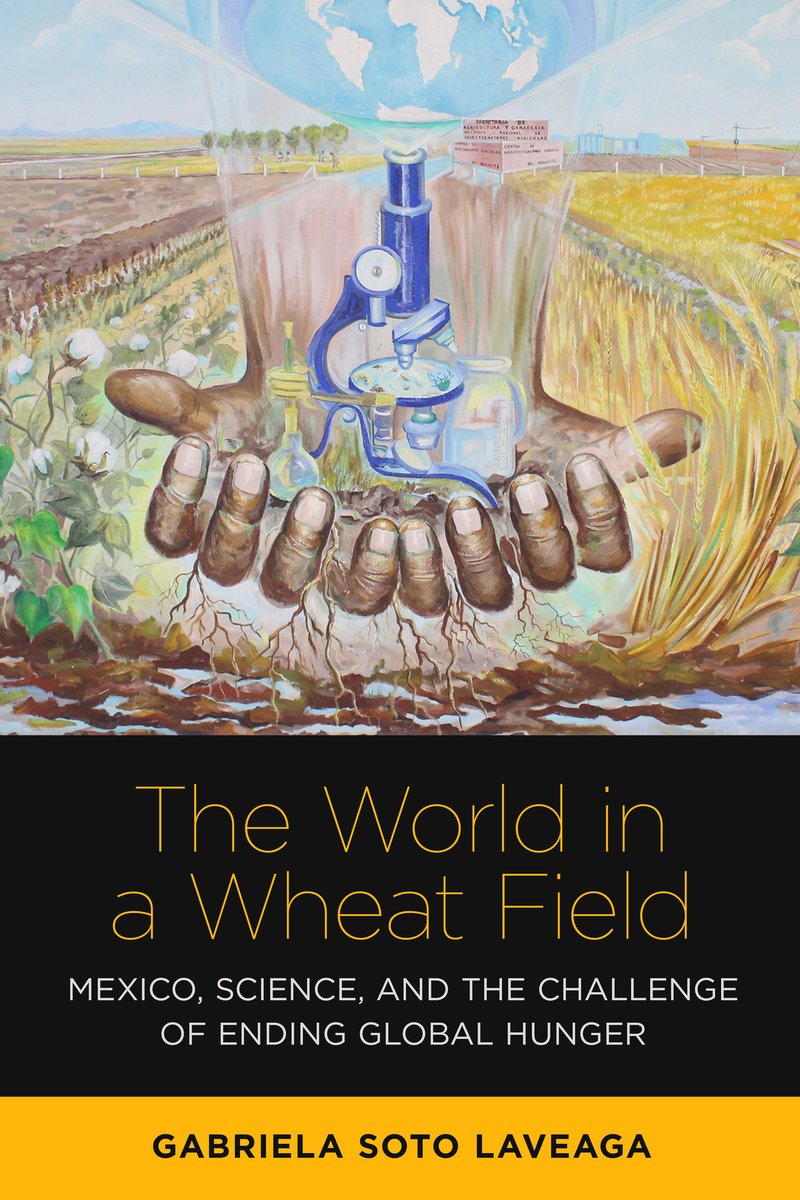
What did it take to grow the wheat that changed farming around the world? Gabriela Soto Laveaga, author of The World in a Wheat Field, answers questions about who developed and tested new wheat varieties in Mexico’s Yaqui Valley, who could afford to grow them, and what the Green Revolution meant for Yaqui communities fighting for land and water.
1. The World in a Wheat Field is set largely at an experiment station in Sonora’s Yaqui Valley. Who was doing the work there day to day, and what did that work actually look like?
This valley has a long history of crop experimentation. The first official experiment station was built by an American irrigation company in 1909. Why? To entice farmers to come settle into this space, the irrigation company had to demonstrate, via science, that a broad spectrum of crops could grow there. Since then, a Sonoran state-run experiment station existed but funding was erratic until Rockefeller Foundation funds materialized in the early 1940s. As for the workers, —the researchers, scientists, irrigation ditch diggers, boys who would chase birds away from experimental crops (an actual job!), those driving the tractors, as well as those making observations and notations,— the majority were Mexican. The work consisted of measuring plants for heat tolerance, for drought, flood, or, especially, breeding new varieties of wheat, but also working in actual laboratories, running the station, etc.
2. Sonoran farmers are usually cast as recipients of the new seeds. What role did they play in testing, adapting, or rejecting them?
Farmers were crucial in this process of seed innovation. Farmers would lend (and still do today) a section of their parcels to try out some of the new wheat seed varieties that were being tested out. Farmers were keen to try new varieties and worked closely with the experiment station because they could see how wheat designed in the experiment station resisted disease and yielded more grain. These farmers were also vocal about which seeds worked and which did not.
3. The Yaqui Valley is Native land. What happened to the Yaqui people, and to their land and water, as the valley became a center of global wheat research?
As with most Native land in the Americas, the Yaqui and other Native inhabitants were pushed off prime farming land, especially land closest to the river. Today most Yaqui neighbors of the experiment station are no longer farmers. Instead, they rent out their lands to commercial farmers. The Yaqui battle for both land and water has been an ongoing one for at least two centuries but became especially violent in the twentieth and twenty-first centuries as Yaqui water and environmental activists have been incarcerated or killed. This is the dramatic backdrop to some of the world’s most important crop research.
4. The new seeds came with fertilizer, pesticides, and irrigation. What did that package cost farmers, and who was left out because they couldn’t afford it?
The case of small-plot farmers going into debt to obtain needed inputs (fertilizer, pesticides, and irrigation) to make the seeds succeed would play out not just in the Yaqui Valley but across the world where these new seed varieties were distributed. This type of farming was not designed for small-plots or for rain-fed fields, it was dreamed up to be idea for commercial farmers who had significant capital and could invest in the inputs and also in heavy machinery. The majority of the world consists of small-plot farmers and they simply could not afford what was needed for this type of farming, so they borrowed money. The debt of these farmers created social chaos wherever this new style of farming went. For example, in India nearly 50% of all farmers are in debt. This led to an “epidemic” of Punjabi farmers committing suicide. According to the Punjab Agricultural University an average of one thousand farmers committed suicide per year between 2000-2015. That is one dramatic example. In the Yaqui Valley, if you are not a wealthy farmer, you cannot purchase the “right” type of seed at the right time.
5. The historian Nick Cullather has described your book as a story of both hope and violence. Where does the violence appear, and why is it so often left out of the Green Revolution story?
There are several types of violence that play out on the ground and which I think is what Nick Cullather was describing. First, is the violence of dispossession. Lands that needed to be taken away for that land to yield more. There is also the violence on the environment. The use of so many agrochemicals polluted rivers, groundwater, and the runoff made it into seas around the world. Finally, there is the violence on human bodies who often use these agrochemicals without protection. The rates of infections and cancers tend to be higher in or around these farmlands.
6. You also document resistance to the wheat program. Who pushed back, and what exactly were they resisting?
The resistance was not necessarily against the wheat program but rather against what the embrace of this style of wheat farming entailed. As remarked above, it was certain seeds, a specific type of farming, and often rigid guidelines that defined success as larger yields.
7. The World in a Wheat Field describes a program that was both deeply local and global. How did the towns and communities of the Yaqui Valley change as their fields became a model for the world?
To answer that question we need to look at the Yaqui Valley not as a uniform space but rather one where several groups (Native, non-Native, immigrants, etc) live and co-exist, though they are in the same valley they don’t have the same rights or opportunities. In this valley for a long time, whomever owned land and had access to water obviously had definite advantages over those who did not have access. The success of wheat farming as defined by the protocols of the Green Revolution (bettered seeds, heavy agrochemical use, irrigation) meant that only farmers who had access to all of these would be deemed successful. Ciudad Obregón in the Yaqui Valley is a wealthy northern Mexican town in large part because of what the neighboring experiment station did: launch the Green Revolution, a new style of farming that was not meant for the majority of the world’s farmers.